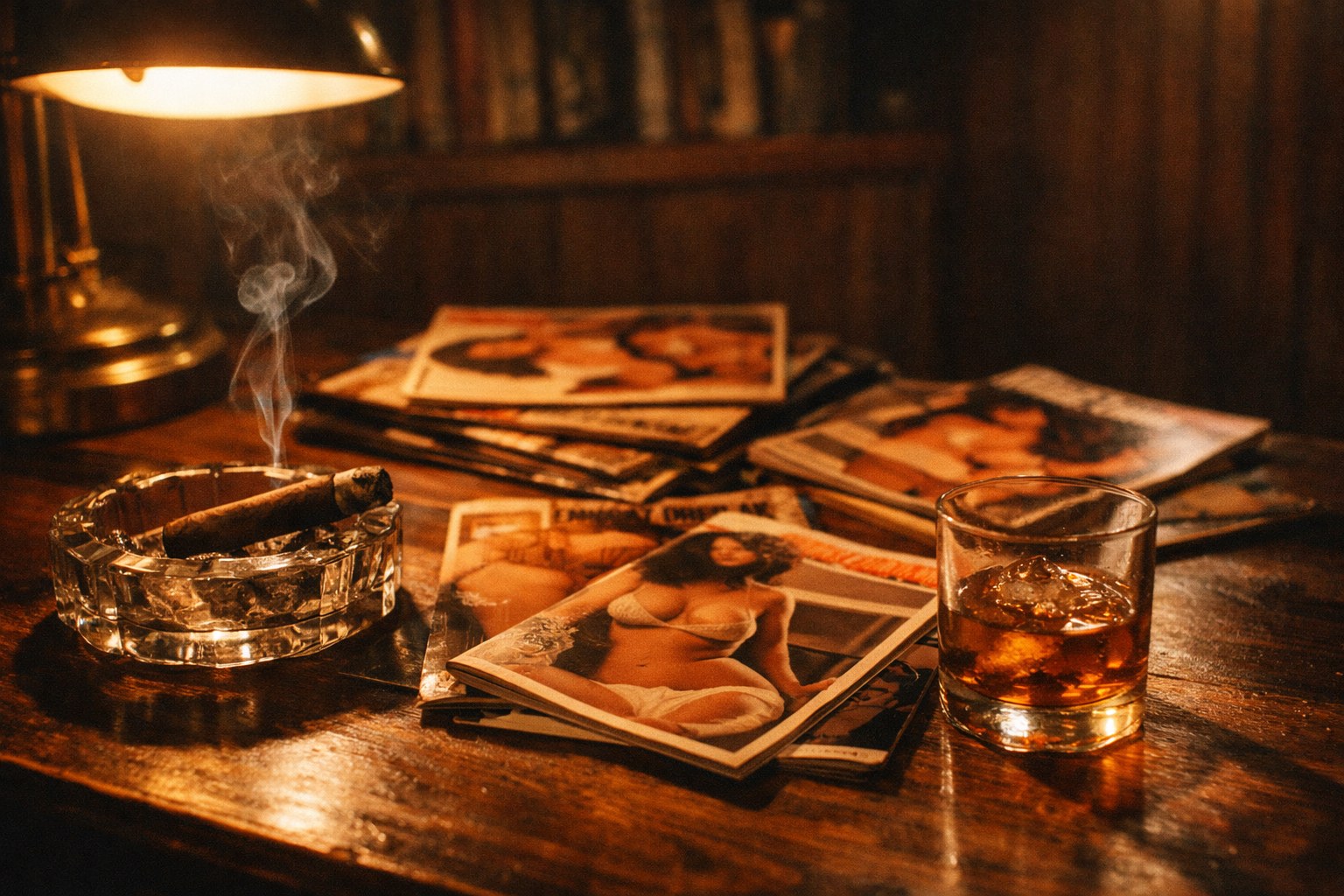
One guy's obsession with the magazines nobody saved
My name is Glenn. I collect old girly mags.
Not the famous ones. I don't care about Playboy or Penthouse—those are documented to death. Every issue cataloged, every centerfold identified, every collector's guide written. You can find them anywhere. They're not going anywhere.
I care about the other ones. The little regional gentleman's magazines that were printed in runs of five or ten thousand, sold at gas stations and drugstores within driving distance of wherever they were published, and that nobody ever thought to save. The ones where the publisher was also the photographer, the ad salesman, and the guy who drove the copies to the newsstand in his station wagon.
I've been at this for about fifteen years, and I'll be honest: it's an obsession. I check eBay every morning. I have saved searches for dozens of titles. I hit estate sales most weekends. I've got a network of friends and fellow collectors who text me photos when they come across something interesting—a box of magazines at a garage sale, a listing on Craigslist, a lead on somebody's grandpa's attic.
Look, I know how it sounds. "Guy collects old nudie mags." I get it. But spend some time with these things and you start to see something more interesting than just the girls.
These magazines are time capsules. The ads tell you what the local economy looked like—timber companies, fishing outfitters, car dealerships, regional beer brands that haven't existed in forty years. The articles tell you what people cared about. And the girls? They're real people from real places. Waitresses and students and office workers who posed for fifty bucks and a few copies of the magazine. They look like people you'd actually meet, not the airbrushed fantasy that the big magazines sold.
Nobody else is preserving any of this. When the last collector dies and his kids clean out the house, those boxes go in the dumpster. Every year, entire publications just vanish. I've tracked down titles that I'm pretty sure no longer exist in physical form anywhere. Gone. Decades of somebody's creative work, just—gone.
Specifically: small, regional, independent adult magazines from roughly the 1960s through the 1980s. The stuff that never made it to a national newsstand. I stay away from the well-known titles—I'm only interested in those small little gems that most people have never heard of.
A few things I look for:
I don't need to keep the originals. I'm happy to scan and return, or to come to you if the collection is large enough. I've driven to six states to pick up magazine collections. This is not a casual hobby.
Most of the obscure titles I find come through eBay. The problem is that sellers don't know what they have. They list a box of "vintage adult magazines" with one blurry photo and a starting bid of ten dollars. You bid blind, hoping the box has something interesting. Sometimes it does. Most of the time it's four copies of Penthouse and a water-damaged Oui. But once in a while you open that box and there's a title you've never seen before from a city you didn't know had a publisher. That's the hit. That's what keeps me going.
My friends know the deal. They'll be at a flea market in Tucson or a junk shop in rural Wisconsin and they'll text me: "Weird old mag, ever heard of this?" Usually I have. Sometimes I haven't. Those are good days.
If you have old magazines, leads on collections, or just want to swap stories about obscure titles, reach out: glenn@dustymags.com.
Seriously. Even if you think it's nothing. One man's "box of old junk" is another man's treasure. I've found complete runs of magazines in boxes that people were about to throw away. Don't throw them away. Tell me first.
No ads, no paywalls, no subscriptions. Just a guy with a scanner and a problem.